
The Coconut crab ( Birgus latro) is the largest land-living arthropod in the world. The species inhabits the coastal forest regions of many Indo-Pacific islands. Generally nocturnal, they remain hidden during the day and emerge only on some nights to forage.They can weigh nearly 9 pounds and live 60 years.
This enormous crab has developed much to adapt to its conditions: climbing skills to fetch food from tree tops; digging skills to burrow underground and into tree trunks to hide; gills to survive in water, or to drink a little saltwater to maintain its body salt.

The life cycle of the Coconut Crab (Birgus latro) is extremely drawn out which causes the species to re-populate slowly. Phase one sees the female crabs travel to the coast to spawn. Four to five larval stages follow, taking 28 days in the ocean, after which the developing crab spends a further 28 days on the ocean floor. The next stage is to come ashore and find an empty shell to hide in. They remain in this temporary housing for 1-2 years and then travel inland where they tunnel underground to a depth of 50mm. In yet another home, the exoskeleton becomes brittle and is discarded and the crab becomes immobile. The crab then eats its old shell to re-absorb minerals while a new shell develops over a 4-week period. The crab can then finally leave its burrow but reproduction cannot occur until they mature between 3.5 and 5 years.

They are herbivorous feeding mainly on dry coconut flesh (by cracking open coconut shells with their powerful claws), dead fruits and leaf but have also been observed eating dead animal carcasses.

The crab population has shrunk throughout its range due to habitat depletion, collecting for food and by introduced animal enemies such as pigs. With rapidly declining Coconut Crab numbers, Vanuatu has implemented a 3-year ban in certain parts of the Republic, on the collection of the world’s largest crustacean. The slow life cycle resulted in an Act aimed at protecting females of egg-bearing age, by prohibiting the collection of any crab whose body is less than 9cm. In length. These actions will hopefully rejuvenate a resource that has become one of the symbols of the nation.

The gathering of Coconut Crabs is not illegal but there is a quota allocation and closed seasons which everyone is asked to obey. Coconut crab populations in several areas have declined or become extinct due to both habitat loss and human predation.It is a worldwide protected species according to the IUCN Invertebrate Red Data Book.
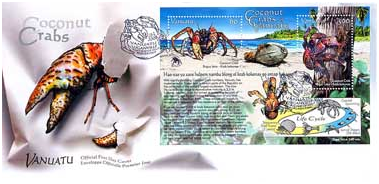
Vanuatu Post is proud to support the efforts being made to ensure the long-term survival of the Coconut Crab in Vanuatu and releases this stamp issue to help raise awareness of this conservation initiative.


