Following the first issued of the stamps featuring seasonal blossoms,entitled ‘Autumn Flowers’ , Jersey Post issued the second series depict the Winter Flowers on the 10th November 2003. The set of stamps comprised six stamps depicted Japanese Quince, Winter Jasmine, Snowdrop, Winter Heath, Chinese Witch-hazel, and Winter Daphne.

Japanese quince 29p,
Japanese Quince or Chaenomeles japonica is a genus of three species of deciduous spiny shrubs, usually 1–3 m tall, in the family Rosaceae. They are native to eastern Asia in Japan, China and Korea.The species have become a popular ornamental shrubs in parts of Europe and North America, grown in gardens for their bright flowers
The leaves are are 3–5 cm long and alternately arranged, simple, and have a serrated margin. The flowers are 3–4.5 cm diameter, with five petals, and are usually bright orange-red, but can be white or pink; flowering is in late winter or early spring. It has small fruit with five carpels ; apple-shaped, 3–4 cm diameter; it ripens in late autumn. and has fruit. Some cultivars grow up to 2 m tall, but others are much smaller and creeping. They are also suitable for cultivation as a bonsai.
Winter jasmine 30p,
Winter Jasmine, is a slender, deciduous shrub native to China. It has arching green shoots and opposite, pinnate, dark green leaves. Each leaf is divided into three oval-oblong leaflets which are about 3 cm long.
As its name suggests Winter Jasmine flowers, in the Northern Hemisphere, from November to March. The solitary flowers have six petals and are bright yellow, about 1 cm across, appearing in the leaf axils.
Winter Jasmine likes full sun or partial shade and is hardy. It tolerates hard pruning and should be pruned in spring immediately after flowering, regular pruning will help to prevent bare patches. It can be propagated using the layering technique. This species of Jasmine can be grown as a bonsai.
Snowdrop 39p,
Snowdrop or Galanthus nivalis is a small genus of bulbous herbaceous plants in the Amaryllis family. There are about 20 species.Most flower in winter, but certain species flower in early spring and late autumn.
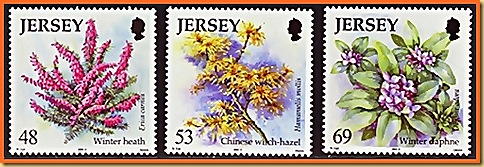
Winter Heath 48p,
Winter heath or Erica carnea is a species of heath native to mountainous areas of central and southern Europe in the eastern Alps, where it grows in coniferous woodlands or stony slopes.
It is a low-growing subshrub reaching 10-25 cm tall, with evergreen needle-like leaves 4-8 mm long, borne in whorls of four. The flowers are produced in racemes in late winter to early spring, often starting to flower while the plant is still covered in snow; the individual flower is a slender bell-shape, 4-6 mm long, dark reddish-pink, rarely white.
It is very widely grown as an ornamental plant for its winter flowering; over 100 cultivars have been selected for variation in flower and leaf colour.
Chinese Witch-hazel 53p,
Chinese Witch-hazel or Hamamelis mollis is a species of witch-hazel native to central and eastern China, in Anhui, Guangxi, Hubei, Hunan, Jiangxi, Sichuan, and Zhejiang.
It is a deciduous large shrub or small tree growing to 8 m tall. The leaves are oval, 8-15 cm long and 6-10 cm broad, oblique at the base, acute or rounded at the apex, with a wavy-toothed or shallowly lobed margin, and a short petiole 6-10 mm long; they are dark green and thinly hairy above, and grey beneath with dense grey hairs. The flowers are yellow, with four ribbon-shaped petals 15 mm long and four short stamens, and grow in clusters; flowering is in late winter to early spring.
The fruit is a hard woody capsule 12 mm long, which splits explosively at the apex at maturity one year after pollination, ejecting the two shiny black seeds from the parent plant.It is widely grown as an ornamental plant, valued for the strongly scented flowers. Numerous cultivars have been selected, for variation in flower colour and size, and in shrub size and habit.
Winter Daphne 69p,
Winter daphne or Daphne odora is an evergreen shrub, grown for its incredibly fragrant, fleshy, pale-pink, tubular flowers, each with 4 spreading lobes and for its glossy foliage. The plant is native to China and Japan.
The plant is fully frost hardy. It requires full sun to part shade. It is found in fertile, slightly acid, peaty, well-drained soils. It will not tolerate transplantation as, like all Daphne, it hates root disturbance. It rarely fruits, but when it does, it produces red berries after flowering in habitat. Daphne odora is propagated by semi-ripe cuttings in summer. It is susceptible to viruses that cause leaf mottling.Plants are not long lived, senescing within 8 to 10 years.


