To commemorate the Argentina’s National Flower Festival, Argentine Post has issued two souvenir sheets depicted the beautiful flower species, such as: Rose, Carnation, Gerbera Jamesonii, Lillium and Delphinium on September 27, 2008.

Gerbera jamesonii Bolus or The Gerbera daisy is perennial flower and reproduces asexually.It is a member of the Gerbera genus.This flower was discovered in Barberton, Mpumalanga Province, South Africa (1889) by Robert Jameson.
Cape Jasmine, or Gardenia jasminoides is a shrub with greyish bark and dark green shiny leaves with prominent veins. The white flowers bloom in spring and summer and are highly fragrant. They are followed by small oval fruit.Cape Jasmine derived from the earlier belief that the flower originated in Cape of Good Hope, South Africa.
Rosa or Rose is best known as ornamental plant grown in the garden and sometime indoors.A rose is a perennial plant of the genus Rosa, within the family Rosaceae. There are over 100 species. They form a group of erect shrubs, and climbing or trailing plants, with stems that are often armed with sharp prickles. Flowers are large and showy, in a number of colours from white through yellows and reds. Most species are native to Asia, with smaller numbers native to Europe, North America, and northwest Africa. Species, cultivars and hybrids are all widely grown for their beauty and fragrance.
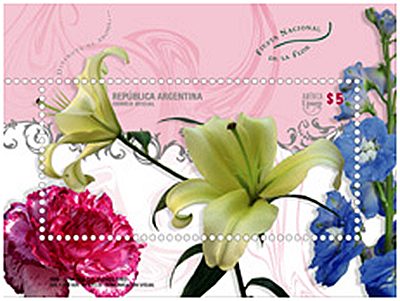
Carnation,is a herbaceous perennial plant growing to 80 cm tall. The leaves are glaucous greyish green to blue-green, slender, up to 15 cm long. The flowers are produced singly or up to five together in a cyme. The flower size are 3–5 cm diameter, and sweetly scented. The original natural flower colour is bright pinkish-purple, but cultivars of other colours, including red, white, yellow and green, have been developed.The flower called as Dianthus caryophyllus or Clove Pink is a species of Dianthus. It is probably native to the Mediterranean region but its exact range is unknown due to extensive cultivation for the last 2,000 years. It is the wild ancestor of the garden Carnation.
Lilium, is a genus of herbaceous flowering plants growing from bulbs. Most species are native to the temperate northern hemisphere. They comprise a genus of about 110 species in the lily family (Liliaceae).They are important as large showy flowering garden plants. Additionally, they are important culturally and in literature in much of the world. Some species are sometimes grown or harvested for the edible bulbs.The large flowers have six tepals. They are often fragrant, and come in a range of colours ranging through whites, yellows, oranges, pinks, reds and purples. Markings include spots and brush strokes. The plants are late spring or summer flowering.
Delfinium, is a genus of about 300 species of perennial flowering plants in the buttercup family Ranunculaceae, native throughout the Northern Hemisphere and also on the high mountains of tropical Africa. The common name, Larkspur, is shared with the closely related genus Consolida.The flower has five petal-like sepals which grow together to form a hollow pocket with a spur at the end, which gives the plant its name.Many species are cultivated as garden plants and for flower arrangements, with numerous cultivars available.All parts of the plant contain an alkaloid delphinine and are very poisonous, causing vomiting when eaten, and death in larger amounts.

 On March 25, 2011, to mark the coming of the spring, Latvia Post has released a new stamp in the Popular Flowers series - the Rose designed artist Lilija Dinere. The flower motif in stamps is very popular among clients, ”Rose is a very beautiful, bright, summery stamp “. Therefore Latvia Post has chosen, Rose as part of a special series dedicated to popular flowers.


