Slovenia Post issued the stamp series depicted snakes, Vipera aspis, Coronella austriaca, Natrix natrix, Vipera ammodytes on September 24, 2009. The stamp set comprised of 3 stamps and one souvenir sheet.
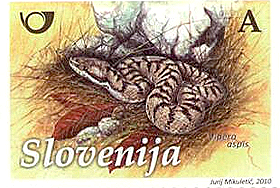
The asp viper (Vipera aspis) is distinguished from our other venomous snakes by its dorsal markings, consisting of two rows of alternating dark transverse stripes. It is smaller than the horned viper and larger than the common European adder. The tip of the snout is slightly upturned. In Slovenia it only lives to the west of the Soča. Until 2001 it was considered extinct in Slovenia but has since been observed several times in the area of Breginjski Kot, on Kobariški Stol and in the area around Sabotin and Korada, at a height above sea level of between 230 and 1,000 metres. It lives in sunny, extensive karst grassland with relatively sparse vegetation, usually by piles of rock, where it finds hiding places. It preys on small mammals (mice, voles) and, more rarely, lizards and birds. It bears live young. For human beings, the bite of an asp viper has painful and unpleasant consequences, but it is not usually fatal. In Slovenia it is considered an endangered species (IUCN: E) and is protected.

The smooth snake (Coronella austriaca) is a relatively small non-venomous snake that can grow to a length of up to 75 centimetres. Its appearance is somewhat reminiscent of the common European adder. It is of a similar size and colour and has a dark pattern on its back. Females retain the eggs within their bodies and in late August or early September give birth to live young. As a result, in summer they can be very fat. The behaviour of the smooth snake is also similar to that of the common European adder. They move relatively slowly and hiss loudly when disturbed. People often mistakenly identify them as venomous and kill them mercilessly. Not only that, but the smooth snake is often found in the vicinity of human habitations, while in Slovenia the common European adder is almost exclusively found in the mountains and hills. The smooth snake can be found all over Slovenia at a height above sea level of between 140 and 1,100 metres, except on the coast. It preys above all on lizards (including slowworms) and occasionally on small mammals. In Slovenia it is considered a vulnerable species (IUCN: V) and is protected.
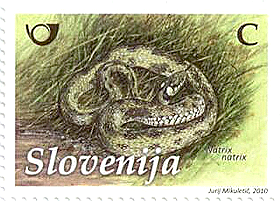
The grass snake (Natrix natrix) is known in Slovene as belouška ('white-eared snake'), a name deriving from the two light patches on its head. It can vary greatly in terms of colour and entirely black specimens are common. It is one of the commonest snakes and is found throughout Slovenia, from the coast to a height of approximately 1,500 metres above sea level. It can grow to up to two metres in length, although specimens this size are rare. The females are larger than the males. It is not dangerous to human beings although its saliva is slightly venomous. It preys mainly on amphibians and their larvae. The grass snake's venom helps it paralyse its prey while it is consuming it. Even so, it is sometimes possible to hear a frog croaking from inside the belly of a grass snake. Grass snakes are quick to flee from human beings. When they are unable to flee, they defend themselves aggressively by raising the front part of the body, flattening the head, hissing and puffing themselves up. But they never bite. Reproduction is oviparous. In Slovenia the species is not considered to be in danger of extinction (IUCN: O1) but is protected.
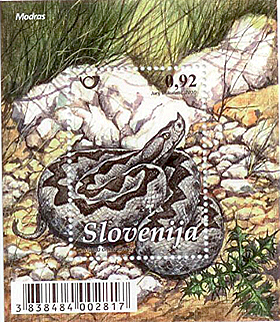
The horned viper (Vipera ammodytes) is the largest venomous snake found in Slovenia. It can be recognised by the little horn on the tip of its snout and by its distinct and usually contrasting dorsal markings consisting of dark, connected diamond-shaped patches. The underside of the tail is frequently red. Males are usually grey while females are brownish or brownish-red, but different specimens can vary greatly in colour. The horned viper can be found throughout Slovenia except in Prekmurje; it is also very rare on the coast. In the mountains it can be found up to a height of roughly 1,700 metres above sea level. Horned vipers like warm, rocky areas with sparse vegetation. They prey mainly on small mammals (mice, voles) and, more rarely, on lizards, birds and birds' eggs. They are good climbers and like to climb through bushes and shrubs. The female horned viper bears live young. It is mainly active at twilight, basking in the sun during the day. It has a powerful venom which is, however, not usually fatal to human beings. In Slovenia it is considered a vulnerable species (IUCN: V) and is protected.


